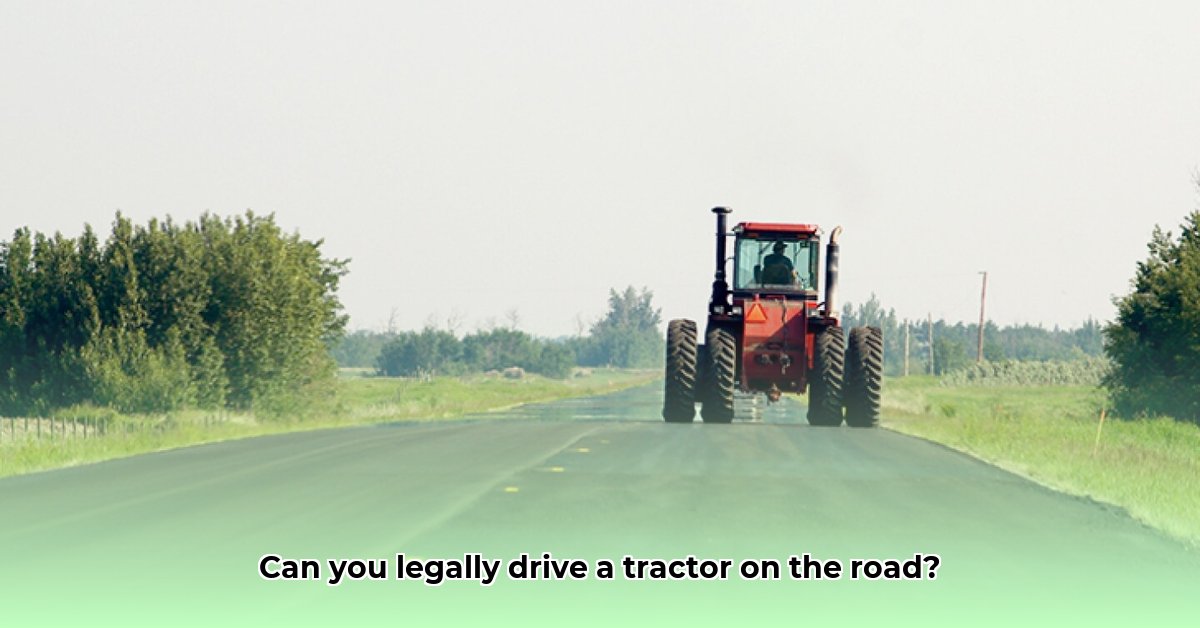
Driving a tractor on public roads—a seemingly simple question with a surprisingly complex answer. The legality of operating a tractor on roadways varies significantly by state, demanding careful consideration of local regulations and safety practices. This guide clarifies the legal landscape and provides actionable steps for safe and compliant operation. For more information on tractor accident statistics, see this resource.
State-Specific Regulations: A Patchwork of Laws
The United States lacks a uniform national standard for tractor road use. Each state establishes its own regulations, resulting in a diverse legal environment. Key variations include licensing requirements, nighttime driving restrictions, towing limitations, and the mandatory use of Slow-Moving Vehicle (SMV) emblems (the iconic orange triangle).
Do you need a special license? Most states don't require a separate tractor license, but a standard driver's license is generally necessary. Specific exceptions may exist depending on the tractor type and operating conditions.
Are there nighttime driving restrictions? Many states restrict or prohibit nighttime tractor operation due to reduced visibility and increased safety risks.
Are there towing limits? The number of trailers or implements you can tow behind your tractor is typically limited. Overloading or improper hitching can lead to penalties.
Is an SMV emblem required? While not universally mandated, the SMV emblem is highly recommended, if not required, in most states to enhance visibility and alert other drivers to the presence of a slow-moving vehicle.
Here's a simplified comparison, but remember to always verify with your state's Department of Motor Vehicles (DMV) or Department of Agriculture for precise regulations:
| State | License Needed? | Night Driving? | Towing Limits? | SMV Emblem? |
|---|---|---|---|---|
| California | Usually not | Generally allowed | Varies by county | Strongly recommended |
| Texas | Usually not | Generally allowed | Varies by county | Strongly recommended |
| Iowa | Usually not | Often restricted | Varies by county | Strongly recommended |
| New York | Might be required | Often restricted | Varies by county | Required in most cases |
| (Your State) | Check your DMV | Check your DMV | Check your DMV | Check your DMV |
Safety Considerations: Prioritizing Safe Operation
Operating a tractor on the road presents inherent safety challenges. Tractors are large, slow-moving vehicles with limited maneuverability compared to automobiles. Prioritizing safety is paramount to prevent accidents.
Maximize Visibility: Utilize bright lights, including headlights, taillights, and turn signals. Consider adding extra lights or reflective tape, particularly during daylight hours, to enhance your visibility to other motorists. Isn't it crucial to ensure other drivers see you well in advance?
Defensive Driving Practices: Follow all traffic laws diligently. Drive at a safe and appropriate speed, signaling turns and lane changes well ahead of time. Anticipate unpredictable behavior from other drivers and maintain a safe following distance. Remember, statistics show that tractor accidents often result from driver error.
Operator Competency: Ensure that the tractor operator possesses adequate training and experience to handle the vehicle safely and effectively. Are you fully aware of the risks involved in operating a tractor on public roads?
Insurance and Legal Liability: Protecting Your Interests
Accidents involving tractors can lead to significant injuries, property damage, and substantial legal costs. Before operating your tractor on public roads, verify that your insurance policy covers such use and understand the extent of your coverage. Liability may rest with you, your employer, or both parties. Being fully insured is a vital safety net.
Actionable Steps for Responsible Tractor Operation
Research State Regulations: Thoroughly review your state’s specific laws and regulations regarding tractor operation on public roads. This involves visiting your state's DMV and Department of Agriculture websites. Don't you want to avoid potential fines or legal issues arising from non-compliance?
Implement Safety Measures: Enhance visibility by adding extra lights and reflective materials. Ensure the tractor is properly maintained and in excellent working order. Implement defensive driving techniques.
Secure Appropriate Insurance: Obtain tractor insurance coverage that explicitly includes road use. Compare policies from different insurers to find the best rates and coverage suited to your needs.
Conclusion: Safe and Legal Tractor Operation
While operating a tractor on public roads may be legal in many circumstances, it requires careful adherence to state-specific regulations and a strong focus on safety. By taking proactive steps to understand the laws, enhance visibility, and secure appropriate insurance, you can ensure safe and compliant operation, minimizing risks and protecting yourself and others. Remember, proactive measures are crucial for responsible and legal tractor use.